When I studied International Relations at Universitas Airlangga, the field felt like it belonged to presidents, foreign ministries and armies. We read about the balance of power, alliances, wars and treaties. The actors that mattered were states, and the question was always how states behave toward one another.
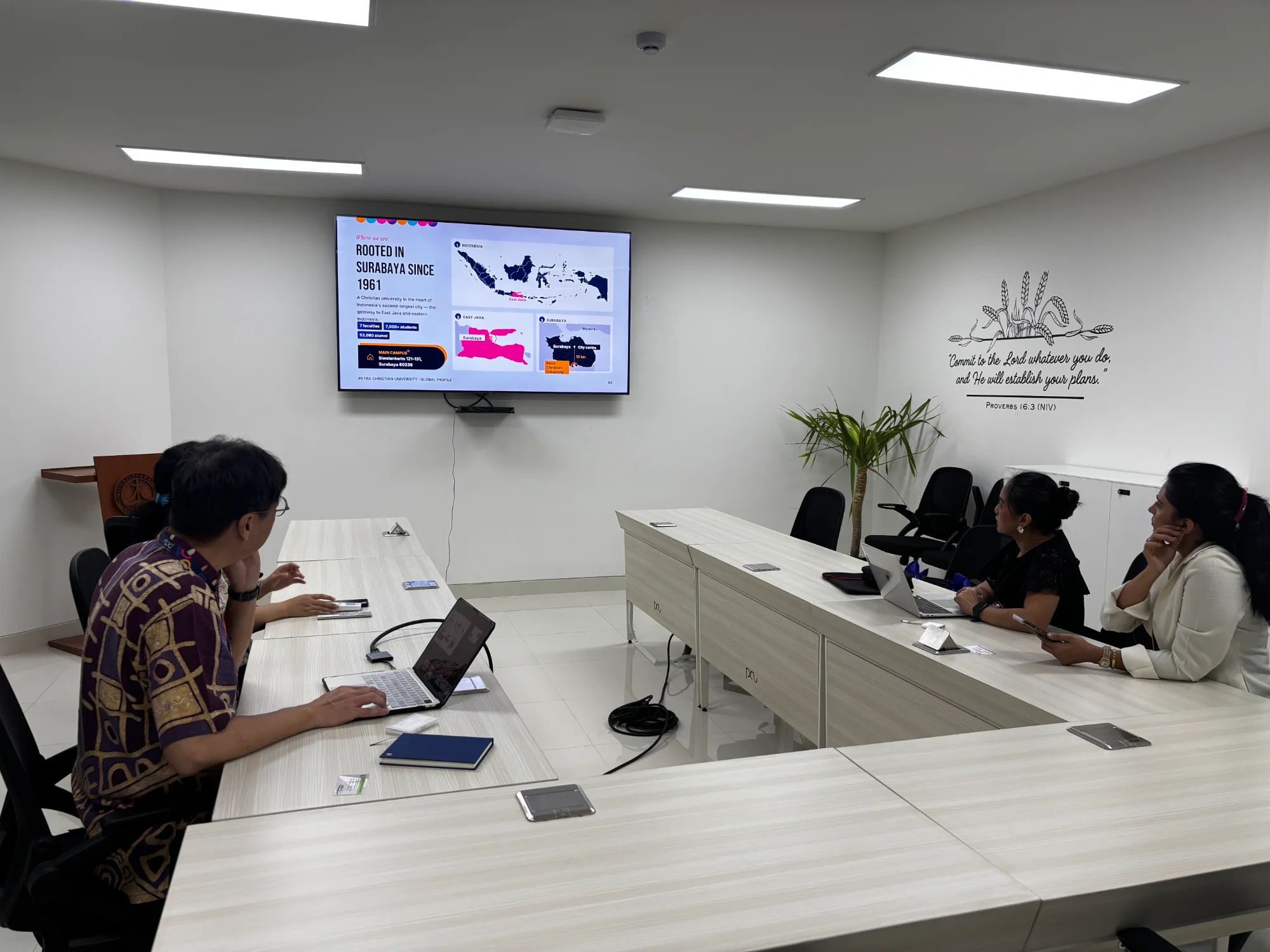
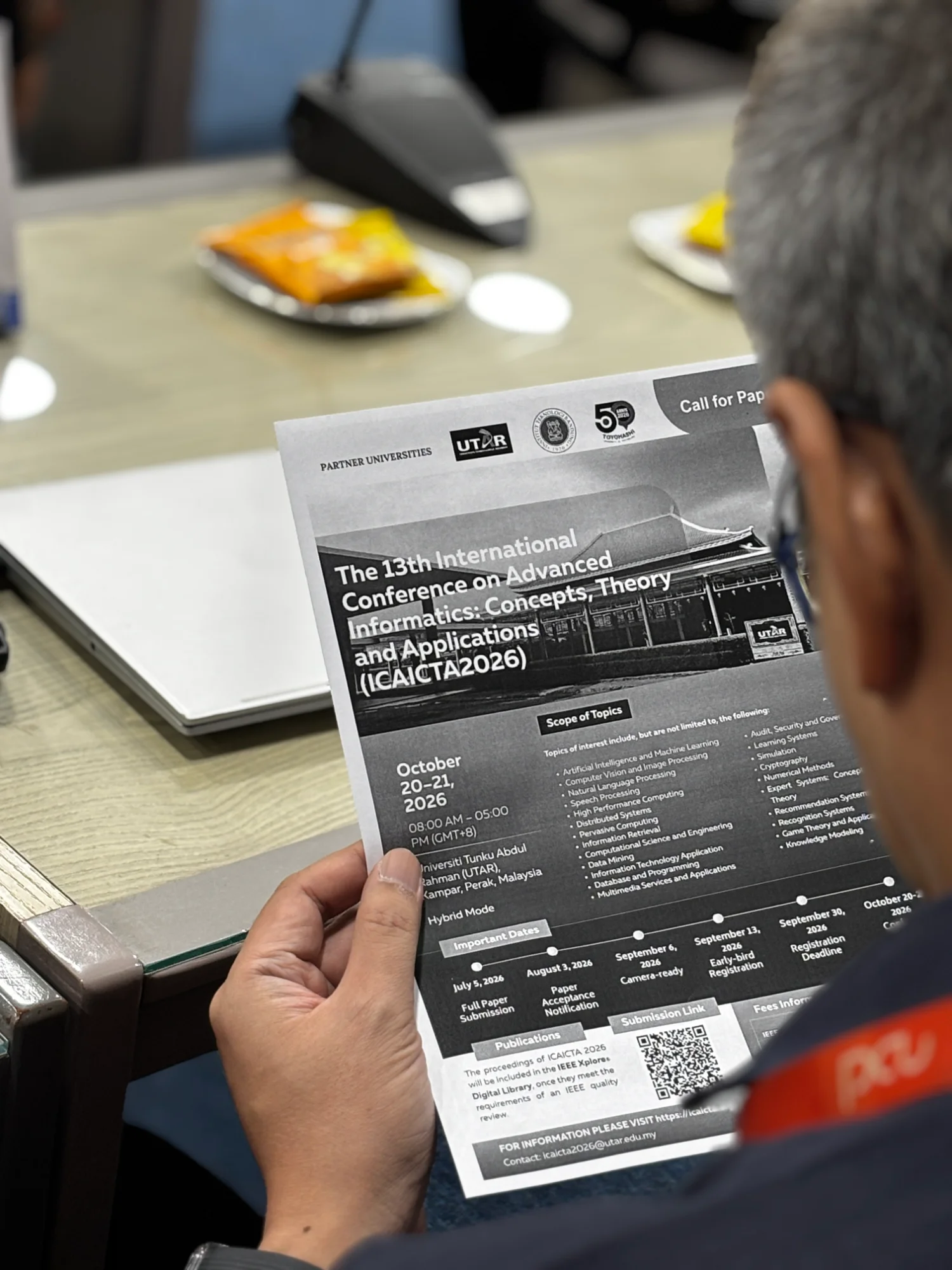
Then I started working in the International Offices of several universities. My days are filled with MoUs and MoAs, partner visits, student exchanges and data requests. None of it involves a foreign ministry. Yet almost every concept I learned in class keeps showing up at my desk.
Universities negotiate with each other like small states. They compete for prestige, form alliances, and follow rules that no single government wrote. The clearest example is the global university ranking. QS World University Rankings and the Times Higher Education (THE) World University Rankings behave very much like what IR scholars call an international regime.
This essay is about that discovery. It argues that IR gives a useful lens for understanding how higher education works today. It also argues that an International Office is, in a quiet way, a diplomatic post.
IR was always wider than I thought
Looking back, the discipline had already prepared me for this. Realism dominated my early reading, but IR has long recognised that states are not the only actors that shape world politics.
Four ideas from my degree now feel especially relevant:
Complex interdependence. Keohane and Nye argued in Power and Interdependence (1977) that ties between societies run through many channels, not only governments. Universities are one of those channels, linking scholars, students and funding across borders.
International regimes. Stephen Krasner (1982) defined regimes as principles, norms, rules and decision-making procedures around which actors' expectations converge. A regime does not need a treaty. It needs shared expectations.
Soft power. Joseph Nye described the ability to attract rather than coerce. Harvard, Oxford and Tokyo attract talent, and that attraction becomes part of their country's influence.
Constructivism and norms. Finnemore and Sikkink (1998) showed how norms spread through a "life cycle" until they become taken for granted. Today, "a good university is a highly ranked university" is close to that stage.
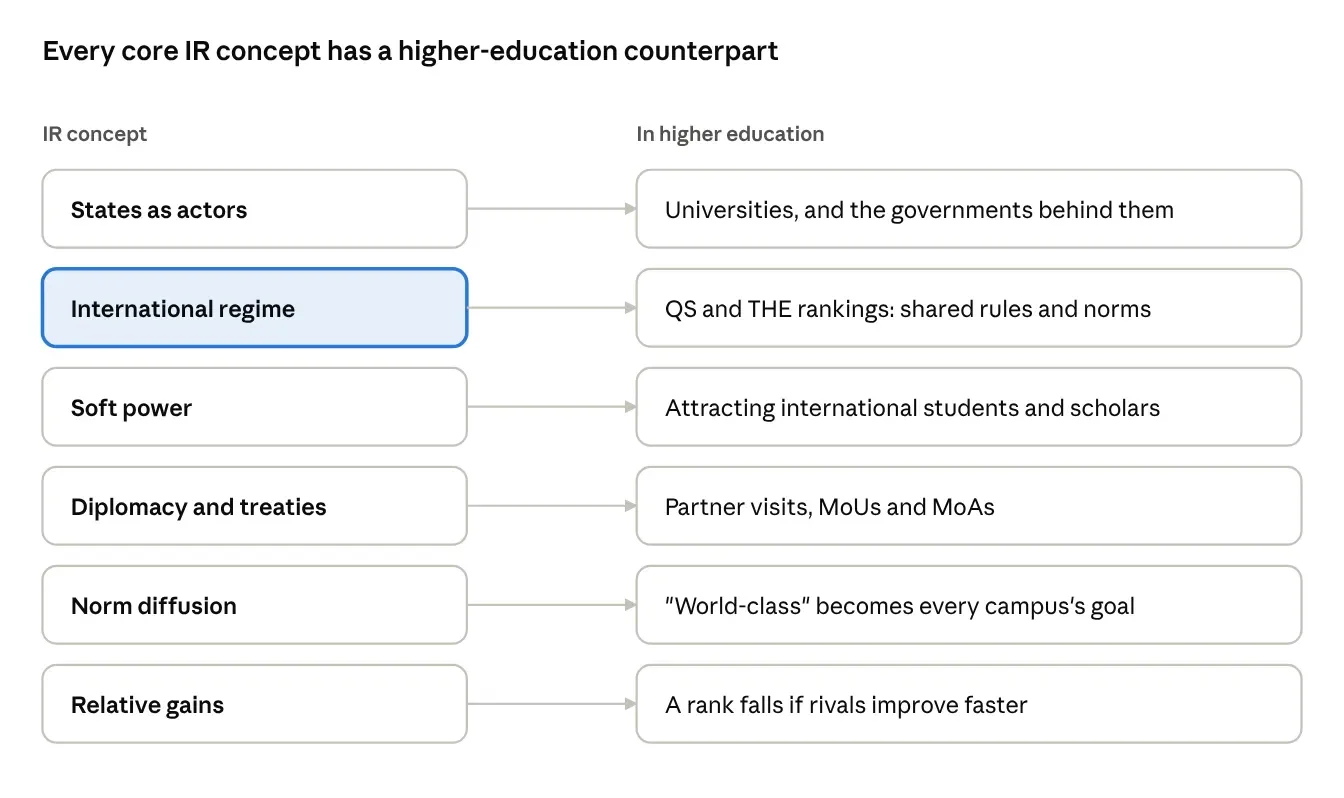
Put together, these ideas describe a field where non-state actors compete, cooperate and follow shared rules. That field is global higher education.
Rankings as an international regimes
Global rankings meet every part of Krasner's definition, even though no state signed them into being. That is what makes them interesting from an IR point of view.
Regime element (Krasner) | What it means | How it appears in QS and THE |
|---|---|---|
Principles | Beliefs about how the world works | Universities can be compared on one global scale; quality is measurable |
Norms | Standards of proper behaviour | A "good" university is research-intensive, internationalised, reputable and employable |
Rules | Specific prescriptions | Weighted indicators: in QS, academic reputation 30%, citations per faculty 20%, employer reputation 15%, faculty-student ratio 10% |
Decision-making procedures | How collective choices are made and enforced | Annual data submission, reputation surveys, methodology changes announced by the ranker, public league tables |
The rule-makers here are not governments. QS is a private company based in London, and THE is a media business. In IR terms, this is private authority: non-state actors setting rules that states and institutions choose to follow.
The rules also change, and everyone adjusts. For its 2024 edition, QS made what it called its largest-ever methodology change. It added three indicators — Sustainability, Employment Outcomes and International Research Network — at 5% each, and raised Employer Reputation to 15%. The result was a major reshuffle, with Tsinghua falling from 14th to 25th. A rule change by one private firm moved the global standing of national flagships overnight.
Internationalisation is written directly into these rules. In QS, international faculty ratio, international student ratio and the international research network carry 5% each. THE has its own "international outlook" pillar. This is why ranking talk reaches the International Office so quickly.
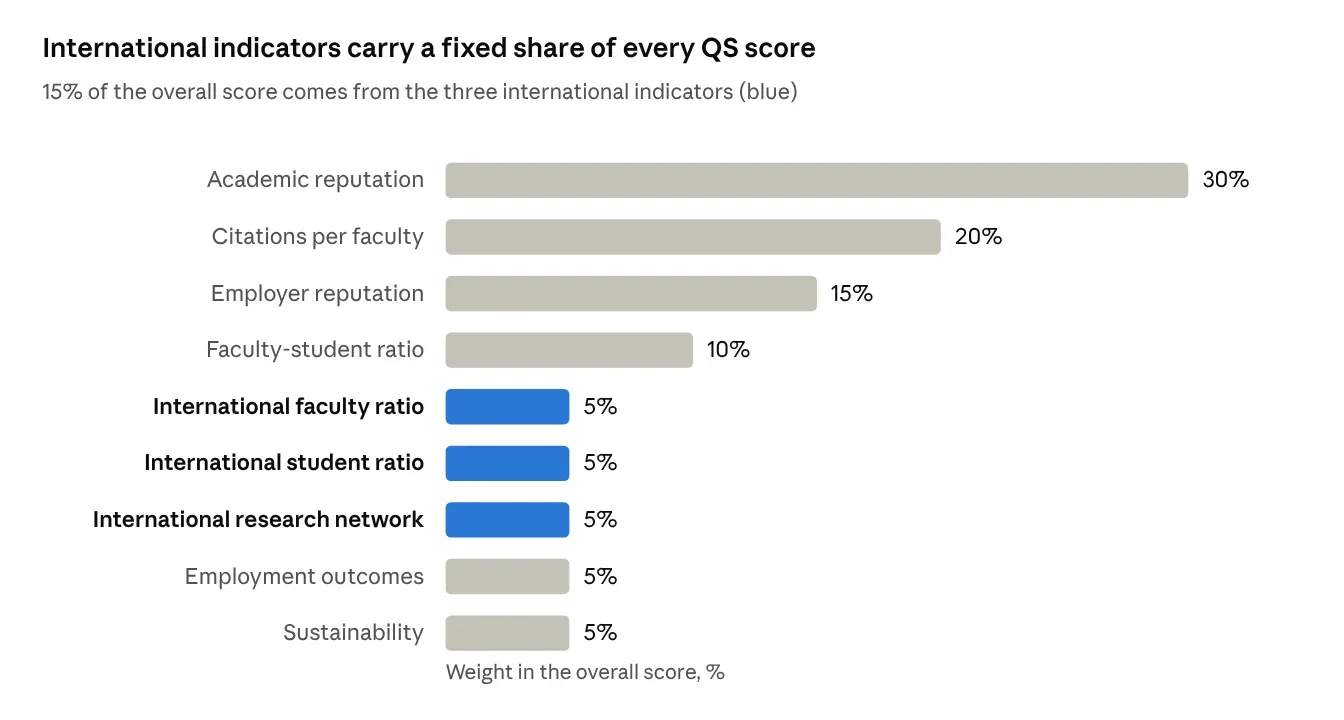
Together, the two reputation surveys make up almost half the score, which is why branding and partner networks matter so much to the International Office.
How the regime reshapes universities
Regimes matter because they change behaviour. Universities rarely say they are "chasing rankings", but their strategies show it. Indicators become targets, and targets become daily work.
Research becomes countable. Citation-based indicators reward indexed publications, especially in English. Many universities now link lecturer incentives and promotion to Scopus-indexed output.
Internationalisation becomes a metric. International students, international staff and co-authored papers are scored directly. An exchange student or a visiting professor is not only an academic experience. It is also a data point.
Reputation becomes a campaign. Reputation surveys reward being known. Universities invest in global branding, conferences and partner networks so that their name comes up when academics and employers fill in surveys.
Universities start to look alike. Sociologists call this isomorphism: organisations copy what successful peers do under uncertainty. A Christian private university in Surabaya and a public flagship in Jakarta end up using the same strategic vocabulary of "world class", "global engagement" and "impact".
Realists would recognise the logic. Rankings create a relative-gains game. A university can improve in absolute terms and still fall, because others improved faster. Position, not progress, is what gets reported.
Constructivists would add a second point. Rankings do not only measure what a university is. Over time, they shape what a university believes it should be.
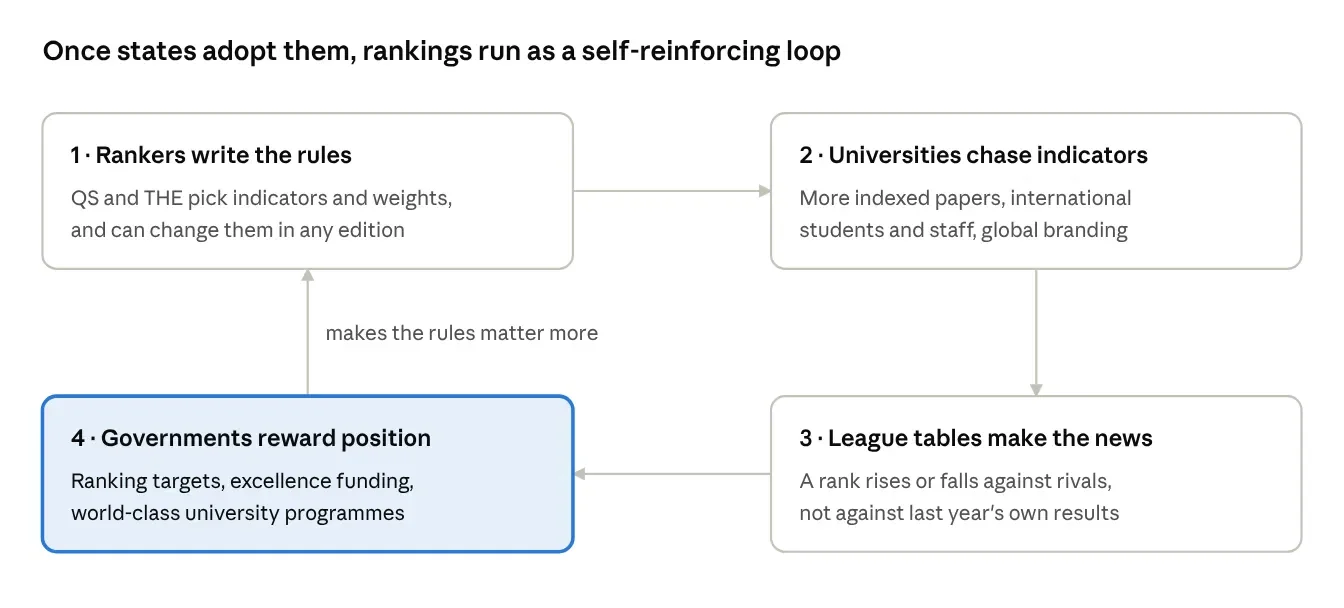
The highlighted step is where private rules gain public force: once governments fund by position, the rankers' authority grows with every cycle.
Universities as proxies for the state
This is where the state comes back into the story. Governments treat ranked universities as national assets, much like a strong currency or a medal count at the Olympics. A top-100 university signals that a country is modern, competitive and worth investing in.
Many governments have funded "world-class university" programmes with ranking targets built in:
Country | Programme | Ranking ambition |
|---|---|---|
Indonesia | Ministry targets for leading universities | |
China | World-class universities and disciplines, China a "higher education power" by 2050 | |
Japan | 13 "Type A" universities expected to reach the global top 100 | |
Russia | Five universities in the world top 100 by 2020 | |
France | Five to ten internationally competitive universities |
The results are mixed, and that is telling. THE credits China's Double First-Class initiative with its universities' rise in Asian rankings, while Russia's 5-100 universities showed no significant rise in citation impact up to 2019. Ranking performance follows long-term state investment, not slogans.
Indonesia is now playing the same game. In QS 2026, Universitas Indonesia reached 189th, the first Indonesian university in the top 200. Universitas Airlangga, my alma mater, placed 287th. These results were reported in national media as national good news, not only campus news.
There is also a soft-power dimension. Highly ranked universities attract international students, and those students often become lifelong links to the host country. Rankings help decide where that attraction flows. For a middle power like Indonesia, climbing the tables is a way to move from being a sender of students to also being a destination.
Hegemony and resistance
Every regime reflects the interests of those who designed it. Critical and Gramscian IR would ask whose idea of a "good university" the rankings encode.
The answer leans toward the Anglo-American research university. English-language publishing, large research budgets and global name recognition all count heavily. Universities in the Global South start the race from behind, and local missions — teacher training, regional development, community service — are largely invisible in the score.
Yet the regime is not uncontested. Some actors have started to exit:
Zurich argued that ranking pressure pushes universities to raise publication counts instead of quality. It also signed the European Agreement on Reforming Research Assessment, a sign of a competing norm emerging.
Still, exit is rare. Even at Utrecht, observers note that few universities followed, because governments in many countries fund universities based on their ranking position. That is classic regime theory: actors may dislike the rules, but leaving is costly while everyone else stays in. Only well-resourced, already-famous institutions can afford to walk away. For most universities in countries like Indonesia, the choice is to play — and to play well.
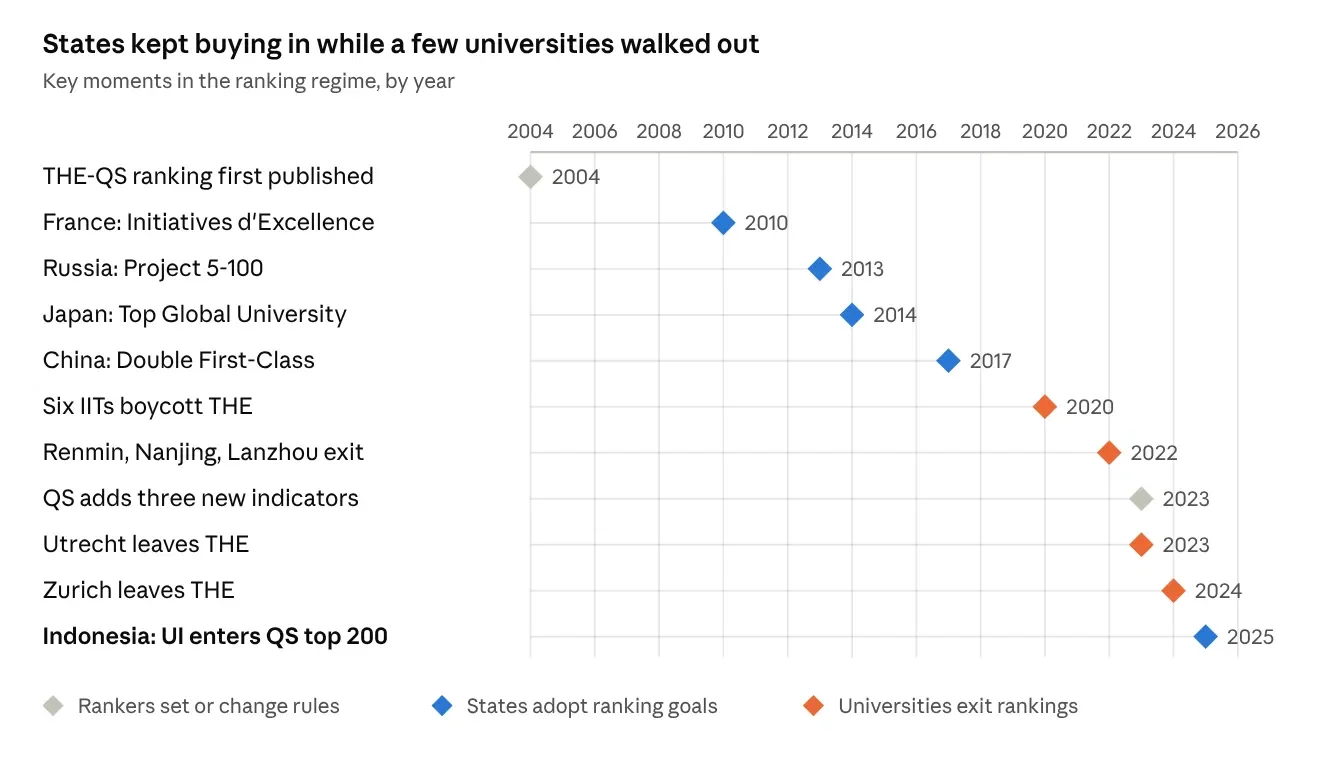
Exits cluster after 2020, yet state adoption never stopped; Indonesia's own milestone came after most of the exits.
The view from the International Office desk
At the International Office, the ranking regime is not abstract. It shows up in the questions I answer each week and in how partnerships are judged.
Much of the work maps neatly onto diplomatic practice:
MoUs and MoAs are treaties in miniature. An MoU signals intent and goodwill, like a joint declaration. An MoA sets binding terms, like an implementing agreement. Drafting them means negotiating language, reciprocity and obligations, just as foreign ministries do.
Partner selection is alliance politics. A partnership with a well-ranked foreign university adds reputation and research links. A partner's ranking is often one of the first things leadership asks about, alongside fit and feasibility.
Mobility is people-to-people diplomacy. Inbound and outbound students and staff build trust between institutions and countries. They also feed the international student and staff indicators.
Data reporting is compliance. Counting international students, visiting lecturers and co-authored papers is how a university shows it follows the regime's rules.
Partner visits are summitry. Delegations, campus tours, gift exchanges and signing ceremonies follow protocol that any diplomat would recognise.
The IR lens also helps me stay critical. Not every partnership that raises a metric serves our students well. A good International Office asks two questions at once: does this help our standing, and does this create real value for learning and research? The best agreements answer yes to both. The worst are signed for the photo and never activated.
Conclusion: IR beyond the state
I once thought International Relations ended at the border of government. Working in a university International Office showed me how wrong that was.
Global higher education has its own anarchy, its own competition for power and prestige, and its own regime. Rankings like QS and THE are written by private actors, adopted by universities, and enforced through reputation and money. Governments then turn those rankings into national goals, so universities end up carrying their country's flag on a global scoreboard.
An IR background helps in three ways. It helps me read the system: who sets the rules, who benefits, and why actors comply. It helps me practise in it: negotiating agreements and building partnerships with diplomatic care. And it helps me question it: remembering that a regime is a human creation, open to reform.
States still matter. But today, some of the most interesting international politics happen in places my textbooks barely mentioned, including a small office on a campus in Surabaya.
Editor: Zefanya K. Nugroho